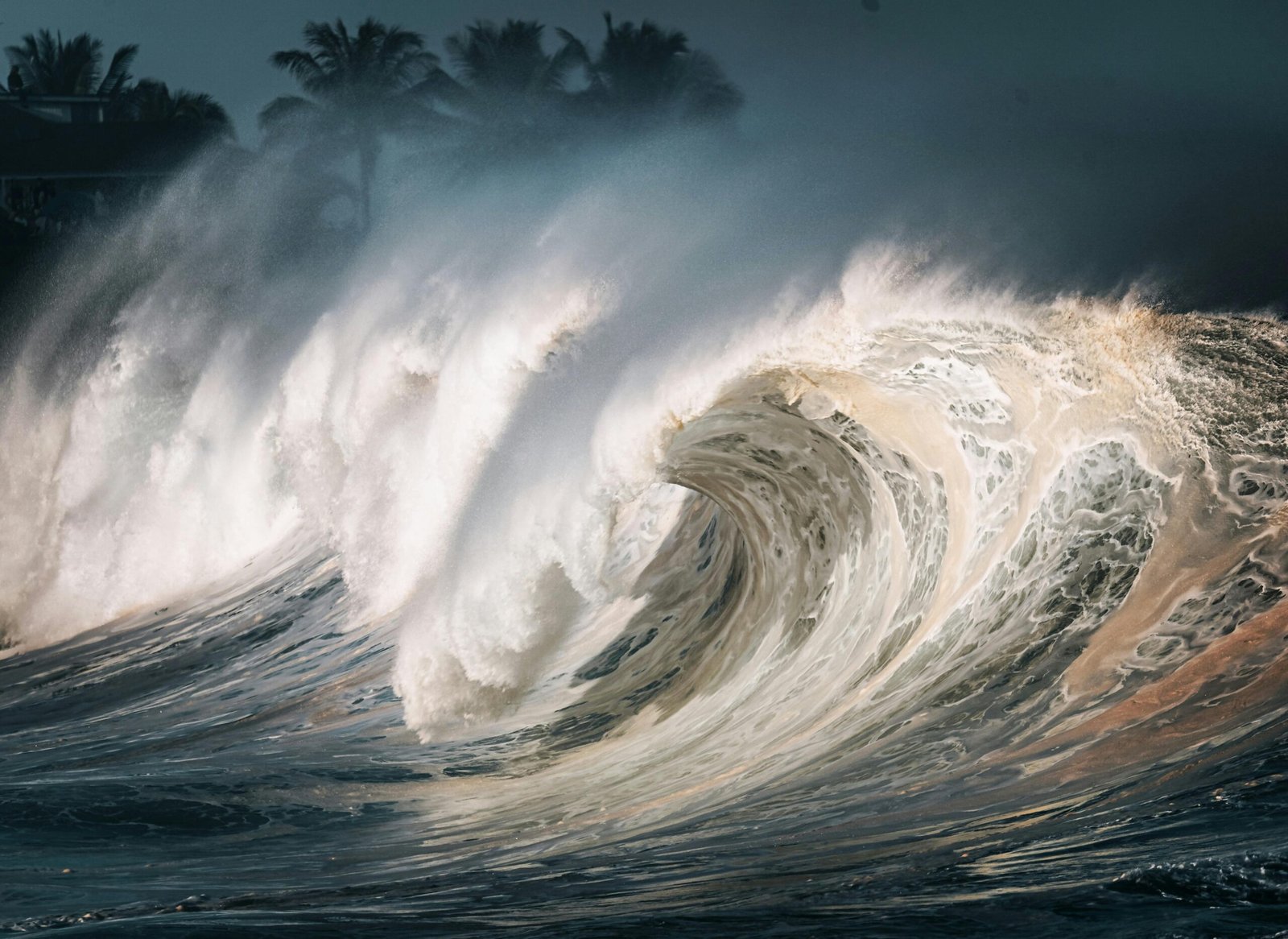
Have you ever wondered how fast a tsunami can travel? The answer is both simple and astonishing. In the deep open ocean, these powerful waves can reach speeds comparable to a modern jet airliner. This incredible velocity is a key reason why tsunamis are so dangerous and why early warning systems are critical.
Understanding their speed is not just about a single number, though. In reality, a tsunami’s velocity changes dramatically depending on its location. The most important factor, by far, is the depth of the water it is traveling through.
Understanding Tsunami Speed: Faster Than You Think
In the vast, deep expanses of the Pacific Ocean, where the average depth is about 4,000 meters (13,000 feet), a tsunami can travel at an incredible 500 miles per hour (about 800 kilometers per hour). To put that into perspective, you could cross the entire Pacific Ocean in less than a day at that speed. This is why an earthquake off the coast of Japan can generate a tsunami that reaches the coast of California just hours later.
However, out in the deep ocean, you might not even notice a tsunami passing. The wave height can be as little as one meter (about three feet). Because the wavelength is so long, stretching for hundreds of kilometers, the wave is almost undetectable to ships. The real danger, therefore, begins when it approaches land.
What Factors Influence How Fast a Tsunami Can Travel?
The speed of a tsunami is primarily governed by one major factor: water depth. The relationship is quite direct. In short, the deeper the water, the faster the tsunami moves. Scientists use a simple formula to calculate this, where the speed is proportional to the square root of the water’s depth.
Several elements play a role in this process. Consequently, understanding them helps us predict a tsunami’s behavior.
- Ocean Depth: This is the single most critical factor. As the wave moves from deep water into shallower areas, it slows down significantly.
- Seafloor Topography: Underwater features like mountains and canyons can influence the wave. For instance, a submerged mountain can act like a lens, focusing the tsunami’s energy on a specific coastal area.
- Energy from the Source: The initial event, such as an underwater earthquake or volcanic eruption, provides the energy. A more powerful earthquake creates a more energetic wave, though it doesn’t change the top speed dictated by depth.
How Does Speed Change as a Tsunami Nears Land?
The transformation a tsunami undergoes as it approaches the coast is what makes it so destructive. As the ocean floor becomes shallower, the front of the wave begins to slow down. However, the energy within the wave has to go somewhere. Since it can no longer be expressed as speed, it is converted into height.
This process is called “shoaling.” For example, a tsunami traveling at 500 mph in the deep ocean might slow to just 20-30 mph (30-50 km/h) near the shore. While this speed is much slower, the wave’s height can grow from a mere meter to over 30 meters (100 feet). As a result, this massive wall of water crashes onto the land with immense force.
Tsunami Speed vs. Regular Wave Speed
It’s important to distinguish tsunamis from regular, wind-driven waves. Their differences in speed and power are enormous.
- Regular Waves: Caused by wind blowing over the water’s surface. They are a surface phenomenon and travel at much slower speeds, typically 5 to 60 mph (8 to 100 km/h).
- Tsunamis: Caused by large-scale disturbances of the ocean floor. They move the entire column of water, from the seafloor to the surface. This is why they carry so much more energy and travel so much faster in deep water.
In conclusion, the speed of a tsunami is a dynamic variable, not a constant. It travels at incredible speeds across deep oceans but transforms into a slower, towering, and destructive force in shallow coastal waters. This knowledge is fundamental for global tsunami warning centers, enabling them to provide timely alerts and save lives.